FLEX Transparent LED Screen Specifications – A Detailed Technical Guide
Transparent FLEX LED screens are a technologically advanced solution designed for modern glass architecture. Their design allows for dynamic visual displays while maintaining high light transmittance, low weight, and minimal impact on existing structures. In this post, we discuss in detail the common parameters of all FLEX LED screens, the differences between individual models, and the practical significance of the technical specifications.
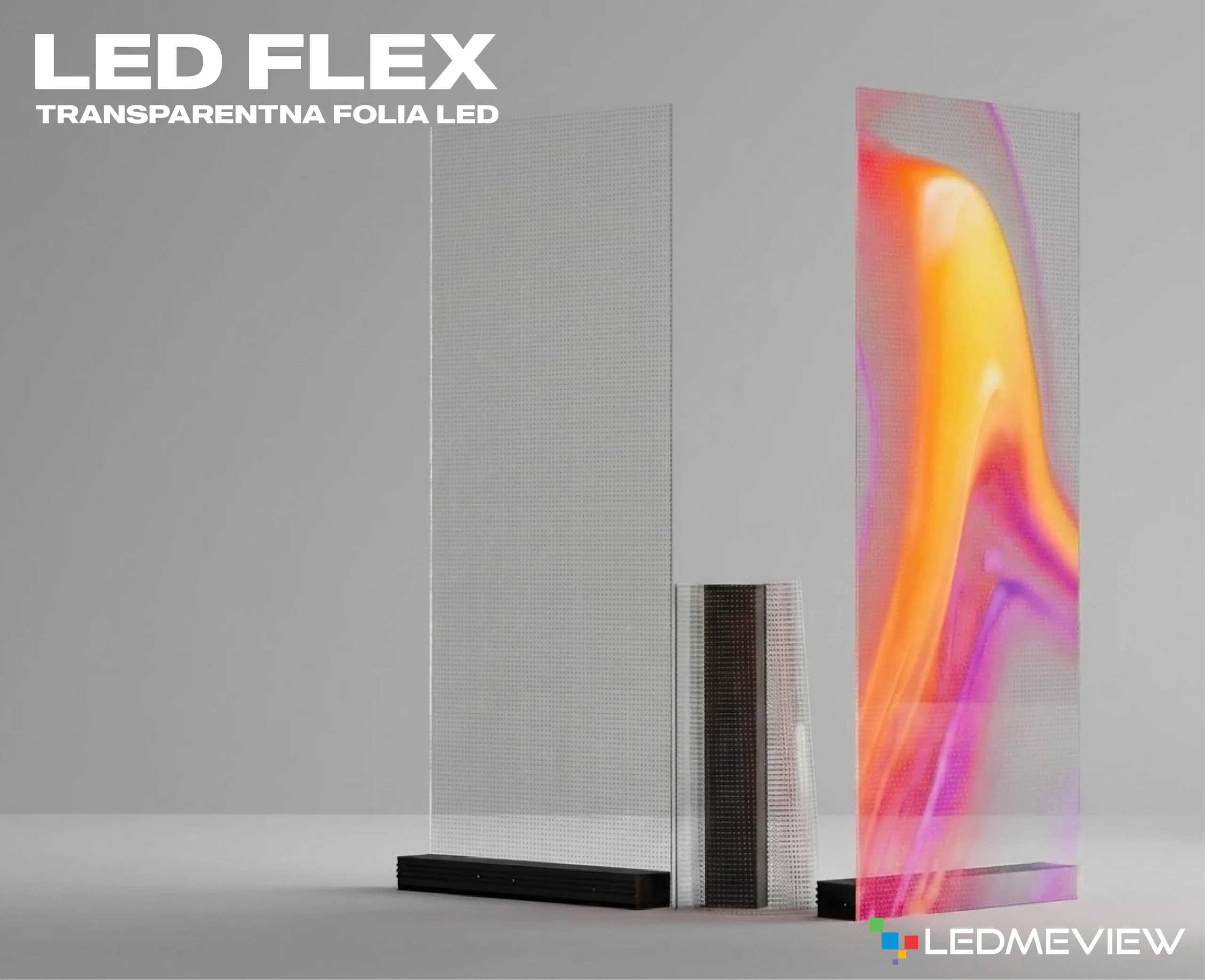
Right from the first interaction with the product—as clearly shown in the photo of the LED FLEX screen—its key feature is immediately apparent: an ultra-thin, flexible structure that allows for installation directly onto a glass surface without the need for steel frames.
Common Specifications for FLEX LED Screens
All LED FLEX models, regardless of pixel pitch, are based on the same design philosophy. They are lightweight, thin, and highly transparent screens, designed for indoor use (IP30) within a wide temperature range of -20 to 55°C.
Each model offers:
- refresh rate of 3,840 Hz,
- true 16-bit grayscale,
- frame rate ≥60 Hz,
- 160° viewing angle,
- LED lifespan exceeding 100,000 hours,
- average energy consumption of approximately 200 W/m²,
- maximum power of 600 W/m².
Thanks to the use of a patented chip embedded directly in the LED, the circuit design has been simplified, while at the same time increasing light transmission and the reliability of the entire system.
Comparison of FLEX LED Models
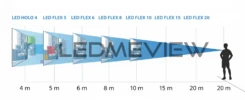
The key parameter that distinguishes FLEX LED models is pixel pitch, which directly affects image density, minimum viewing distance, and transparency. Models with a smaller pixel pitch offer higher image detail, while a larger pixel pitch provides greater light transmission and a better visual effect when viewed from a greater distance.
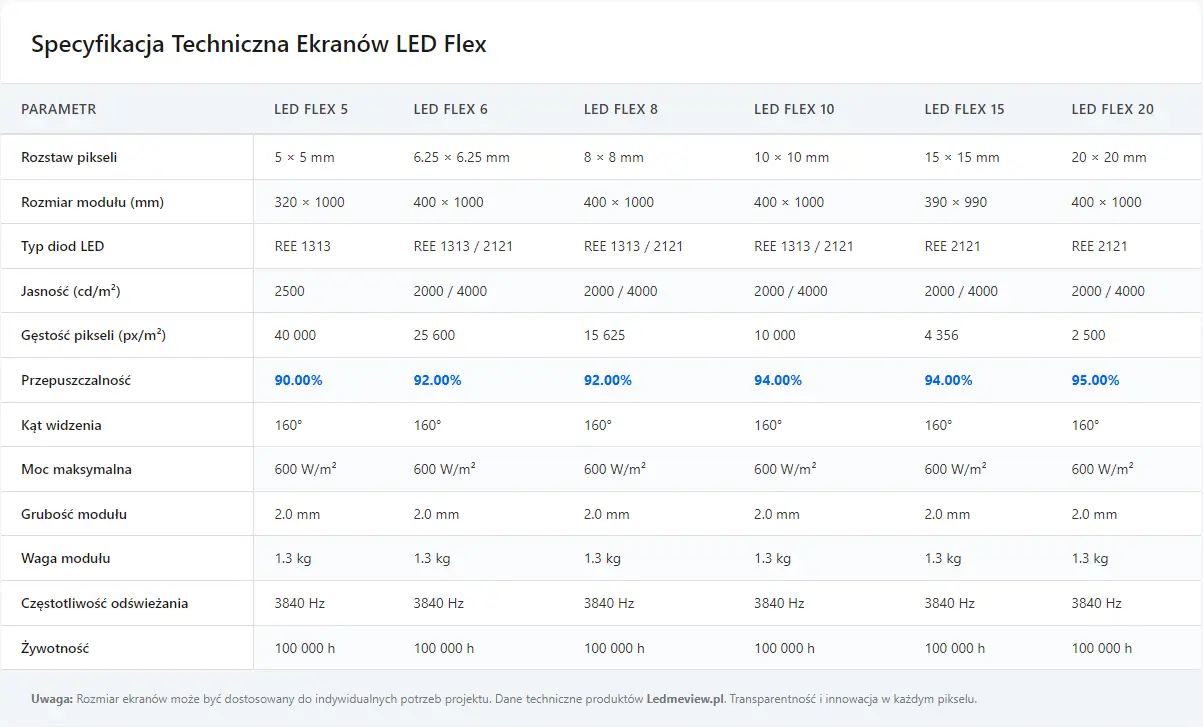
The comparison table clearly shows how parameters such as pixel density, brightness, and transmittance vary depending on the selected model—from the P5 to the P20.
Transparency, lightness, and flexibility
One of the key advantages of FLEX LED screens is their high light transmittance, exceeding 90%. In practice, this means that the screen does not block light from entering the interior and does not visually interfere with the glass facade.
The modules are approximately 2 mm thick and weigh about 1.3 kg, which means they place very little load on the building’s structure. Their flexible design allows them to be installed even on irregular and curved surfaces. Installation is kept to a minimum—the screen can be adhered directly to the glass and connected to a power source and signal.
Differences Between the LED FLEX Models
The most important difference between the various LED FLEX models is the pixel pitch, which affects:
- minimum viewing distance,
- pixel density,
- level of transparency,
- image detail.
A comparison table of all FLEX LED models clearly illustrates these relationships. The P5 model offers the highest pixel density (40,000 px/m²), at the expense of lower light transmission, while the P20 model features the highest transparency (95%) and is designed for large surfaces viewed from a distance.
There are also differences in module sizes and the types of LEDs used (REE 1313 and 2121), but parameters such as brightness, power consumption, and refresh rate remain consistent across the entire series.
Detailed Specifications
FLEX LED Series
Transparent Solutions from Ledmeview.pl
LED FLEX 5
LED FLEX 6
LED FLEX 8
LED FLEX 10
LED FLEX 15
LED FLEX 20
Each LED FLEX model is designed for different display conditions and viewing distances. Differences in pixel pitch, LED type, and light transmittance allow the screen to be precisely tailored to the nature of the project—from displays viewed at close range to large glass facades visible from several or over a dozen meters away.
Intelligent reliability and operational stability
FLEX LED screens utilize advanced solutions that enhance reliability. Support for bidirectional “Drive-in” LED control ensures continuous display operation even in the event of a single-point failure. If an incorrect signal, power, or ground connection is detected, the LED is automatically turned off, eliminating random flickering.
As a result, the system maintains image stability even during intensive, long-term use.
Summary
FLEX transparent LED screens are a comprehensive solution for projects requiring a modern aesthetic, high-quality imagery, and minimal impact on the architecture. The common technological foundation shared by all models ensures consistent performance, while the variety of pixel pitches allows the screen to be precisely tailored to a specific viewing distance and the nature of the project.
The combination of high transparency, low energy consumption, flexible design, and long service life makes LED FLEX a technology ready for many years of trouble-free use in the most demanding applications.